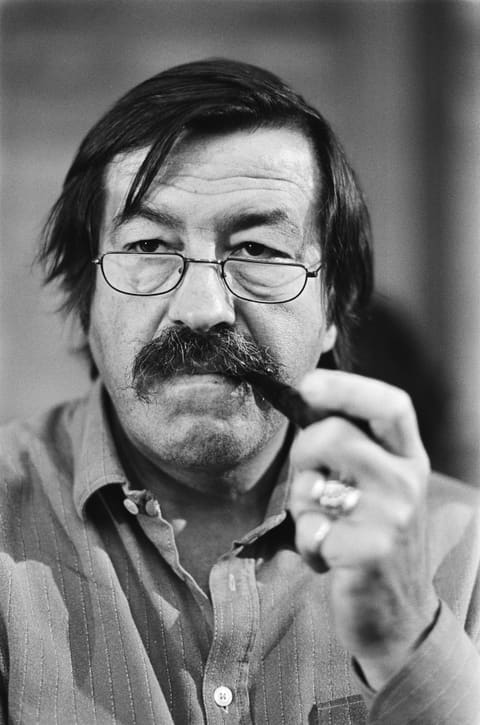
Portrait of Günter Grass

Register of figures · No. 278 of 749

Günter Grass

Role
German literature Nobelist
Lived
1927–2015
Field
Intellectual life
Strongest axis
Democracy 87%

German novelist, 1999 Nobel laureate, author of The Tin Drum. A Social Democrat, he backed Willy Brandt and criticized fast reunification; in 2006 he revealed serving in the Waffen-SS at 17, and in 2012 he published a poem critical of Israel.

In this catalog, Günter Grass leans most strongly toward Democracy 87%. The scores below describe the recorded profile across all twelve axes.

How close are you to Günter Grass?

Your latest completed test can be compared with this profile. See your overall match and the three axes where you differ most.

Portrait of Günter GrassYour closeness to Günter Grass—

Take the test to see your match.

The twelve axes

Where Günter Grass sits across twelve axes, organized into four categories. Each note explains what the axis measures.

Government

  • Federal 63%Unitary

    Federal leaning. Regional autonomy and the concentration of national authority.

  • Democracy 87%Autocracy

    Democracy leaning. Public participation and the concentration of political leadership.

  • SecurityLiberty 67%

    Liberty leaning. The balance between public order and individual liberty.

Diplomacy

  • Non-interventionist 64%Nationalist

    Non-interventionist leaning. Foreign intervention and the pursuit of national interests.

  • MilitaristPacifist 81%

    Pacifist leaning. The role of military force and peaceful cooperation.

  • AssimilationMulticulturalism 76%

    Multiculturalism leaning. Cultural assimilation and the accommodation of diversity.

Economy

  • Public 81%Private

    Public leaning. Public ownership and private enterprise.

  • Planning 69%Free market

    Planning leaning. Economic planning and market coordination.

  • Protectionism 57%Globalism

    Protectionism leaning. Domestic protection and international trade.

Society

  • Irreligious 83%Religious

    Irreligious leaning. The role of religion in public life.

  • Progressive 78%Traditionalist

    Progressive leaning. Social change and inherited traditions.

  • TechnologyBiology 70%

    Biology leaning. Technological change and the preservation of human nature.

What stands out

Compared with the median of all 749 figures in the catalog.

Most distinctive axis

Progressive – Traditionalist

Günter Grass: Progressive 78%. The catalog median is Traditionalist 61%.

Most ordinary axis

Protectionism – Globalism

Günter Grass: Protectionism 57%. The catalog median is Protectionism 53%.

Who is closest in the register

Closest ideologies
Sources and image credit

Portrait reference: View original source.

Biography and scores are from this project’s figure catalog.

About these positions

These scores are reference estimates for comparison, not an official statement by the person or an endorsement. A match describes similarity between recorded scores. Read about the method or suggest a correction.

Keep exploring